
- Category Web Development
Venkon came to Panda Team at the point where organic search had to support an already strong offline and online presence. The catalogue was growing fast, new brands and categories were added every month, and the team needed a clear strategy for how the site should scale in search. The task was to turn a technically capable store into a consistently discoverable, SEO-driven long-term sales channel for the Venkon team.
Project Background
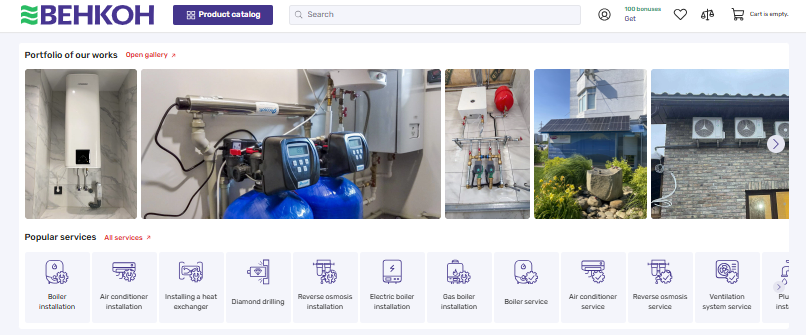
Venkon is an omnichannel retailer of home appliances and engineering solutions in Ukraine. The brand combines a large online store with physical locations in Kyiv and Lviv, offering ventilation, heating, electrical equipment, water filtration, plumbing and other systems for the home and business.
The scale of the catalogue is significant: around 60,000 products, more than 2,200 brands and tens of thousands of customer reviews. Venkon not only sells equipment, but also provides installation, design and servicing, positioning itself as an “expert in engineering solutions” rather than a typical electronics store.
As the assortment and service portfolio grew, the company needed a more systematic approach to SEO. Panda Team was brought in to improve the way the site is indexed, displayed in search and used by visitors — with a focus on product card optimization, metadata, catalogue structure, speed and navigation to grow organic traffic.
Key Challenges Facing the Venkon Project
From the initial audit and discovery phase, Panda Team combined analytics, search data and a manual review of key catalogue sections to understand how the site behaved for both users and search engines.
This revealed several core challenges:
- Very large and diverse catalogue. The site covered home appliances, climate systems, water treatment, plumbing, smart home devices and more, across thousands of SKUs and brands. Without a clearly structured semantic approach, many categories and product cards competed for similar queries or did not fully match the wording customers used in search.
- Metadata and structure not fully aligned with SEO tasks. For a part of the catalogue, page titles, descriptions and headings were not sufficiently differentiated or tied to specific keyword groups. This reduced snippet quality in SERP, made it harder for search engines to understand the role of each page and limited the growth of organic traffic.
- Product cards that underused SEO potential. Product pages contained core information, but in many cases descriptions, attributes and internal linking were not systematically optimized for search demand. Important commercial queries related to specific models, use cases and technical parameters were not always reflected in product content.
- Catalogue navigation and filters overloaded by growth. As the assortment expanded, navigation and filters became more complex. Some important combinations were not easy to reach, even though they reflected real search behaviour. This affected UX and reduced the chances of landing on the most relevant page from search results.
- Performance concerns for a growing e-commerce site. A large number of images, scripts and dynamic catalogue elements affected speed on certain templates. For a site with many product and category pages, even small performance issues have a visible impact on user engagement and, indirectly, on SEO.
Taken together, these challenges showed that Venkon’s organic channel had strong potential, but needed a more structured foundation: clearer semantics, better-optimized product cards, improved metadata and a navigation model that matched how customers actually searched and shopped.
Goals and Tasks for The Panda Team
To turn the audit findings into an actionable plan, Panda Team and Venkon aligned SEO tasks with business priorities: growing qualified organic traffic, strengthening the visibility of key product lines and improving conversion from search.
Based on this alignment, they agreed on the following specific goals:
- Build a structured semantic base for the catalogue. Map search demand to main product groups and brands, with a focus on low- and mid-frequency commercial queries that bring ready-to-buy users.
- Optimize product cards and on-page content for search. Enrich product descriptions, attributes and internal links so that important models and configurations are clearly visible for both users and search engines.
- Rework metadata and catalogue structure. Reduce duplication, clarify the roles of categories and subcategories, and improve how key sections are presented in SERP.
- Improve navigation and site performance. Simplify catalogue navigation in line with real user journeys and speed up key templates to support better UX and SEO metrics.
- Achieve measurable growth in visibility and conversions from organic traffic. Track changes in rankings and user behaviour on organic sessions to confirm that structural improvements translate into business results.
Together, these goals formed a clear roadmap that connected technical SEO work with Venkon’s strategic objectives as an omnichannel retailer.
Solutions Applied to the Venkon Project
To reach these goals, Panda Team focused on a set of SEO and UX improvements designed to work together as a single system. The aim was to strengthen the foundations — semantics, product content, metadata, structure and speed — so every important product line could rank and convert more effectively.
1. Product card optimization
A key direction was the improvement of product cards, which act as the final step before purchase and a frequent landing point from search.
Panda Team:
- Reviewed existing product pages in major categories.
- Identified gaps in descriptions where search-relevant details were missing or not clearly structured.
- Recommended patterns for product names and descriptions that reflect how users search.
- Optimized the use of product attributes and specifications so that filters and search engines can read them consistently.
- Strengthened internal linking from product cards to related categories, services and accessories where appropriate.
This made product pages more informative for users and more predictable for search engines, particularly for detailed commercial queries.
2. Metadata and catalogue structure optimization
To support better indexing and snippets, Panda Team reworked metadata and adjusted parts of the catalogue structure.
The team:
- Updated titles, meta descriptions and headings for key categories, subcategories and brand sections, aligning them with semantic groups and real search phrases.
- Reduced overlaps between similar pages so that each important section had a clear focus and did not compete with neighbouring categories for the same queries.
- Clarified the hierarchy within the catalogue so that priority categories, top brands and service offerings were easier to discover from both search and internal navigation.
As a result, search engines received clearer signals about which pages should rank for which topics, and users saw more relevant, informative snippets in search results.
3. Improving navigation and catalogue filters
With tens of thousands of products and multiple service lines, navigation can easily become overloaded. Panda Team focused on making it easier for users to move from general interest to a specific solution.
Key steps included:
- Reviewing the existing system of filters and top categories against real search behaviour and sales priorities.
- Prioritising filter options that correspond to frequent query patterns (e.g. by equipment type, capacity, installation type, energy efficiency or brand).
- Ensuring category and filter pages support user journeys like “find ventilation equipment for a specific room type” or “select a boiler for a given capacity range”.
- Aligning navigation elements with the way Venkon positions itself: not just as a seller of devices, but as a provider of engineering solutions from selection to installation.
This work improved usability and reduced the number of steps needed to find a suitable product, while also creating clearer landing points for search.
4. Site performance and technical improvements
Because site speed directly affects both UX and SEO, Panda Team paid attention to performance on key templates — especially category listings and product cards.
Within the scope of the project:
- Bottlenecks in loading product and category pages were identified, particularly where large images or scripts slowed down rendering.
- Recommendations were implemented to optimise images, cache static assets more effectively and reduce unnecessary page weight.
- The team monitored how these changes affected core interaction metrics such as time to first contentful paint and overall page responsiveness.
Faster loading times made it easier for users to browse multiple products and categories in one session, while helping search engines crawl more of the site efficiently.
Achieved Results with Panda Team: Before & After
Thanks to combined work on product cards, metadata, catalogue structure, navigation and performance, Venkon significantly improved how search engines and users interact with the site. Before the project, organic traffic depended on a narrow set of generic queries, and navigation did not always match real search behaviour.
After optimisation, the site began to capture a wider range of low- and mid-frequency commercial queries across ventilation, heating, water purification, plumbing and home appliances. Product cards became more informative, snippets more relevant, and organic traffic more qualified, strengthening Venkon’s positions for key product groups.If you want to achieve similar SEO growth for your own multibrand store, contact Panda Team to plan your optimisation roadmap!
Tech Stack

Jira

Google Workspace

Miro

ClickUp
Google Analytics

Google Ads

Semrush